
Updated with 2026 CDC Guidelines – 12 min read
Every year, HPV-related cancers affect tens of thousands of people — and yet a safe, effective vaccine exists in hospitals nearby that can prevent most of them. If you’re a parent navigating whether to vaccinate your child, this guide cuts through the noise.
Human papillomavirus (HPV) is the most common sexually transmitted infection worldwide. About 13 million Americans get HPV every year, including teenagers. The good news: the HPV vaccine is one of the most rigorously tested vaccines in history, and 2026 brings meaningful updates that make protecting your child simpler than ever.
- 90% of HPV-linked cancers the vaccine can prevent
- 9 HPV strains covered by Gardasil 9
- 80+countries using the 1-dose schedule
- 15+years of vaccine safety data
How Ayushman Bharat Pradhan Mantri Jan Arogya Yojana (PM-JAY) Can Help With HPV Vaccination
Families eligible under Ayushman Bharat Pradhan Mantri Jan Arogya Yojana (PM-JAY) can receive affordable or cashless healthcare services at empanelled hospitals across India. While the Human Papillomavirus (HPV) Infection vaccine—such as Gardasil 9—may not always be directly covered in every case, Ayushman card holders can still benefit from consultations, diagnostic services, and preventive healthcare guidance through network hospitals. Parents can check the empanelled hospital list on Hospital List Section to find facilities where doctors can advise on HPV vaccination and other preventive health services for children.
Latest HPV Vaccine Updates in 2026: New Guidelines and Research Findings
The landscape shifted in January 2026 — here’s what changed and why it matters for your family.
The biggest change

One dose is now enough for children aged 9–14
In January 2026, the CDC officially updated its childhood immunization schedule with a landmark change: children ages 11–12 now need just one dose of the HPV vaccine, down from the previous two-dose recommendation. This makes the United States one of more than 80 countries — including the UK, Canada, and Australia — following a single-dose schedule.
January 2026 — CDC Update
Children ages 9–14 starting the series: 1 dose recommended (previously 2 doses).
Ages 15–26 who start the series or are immunocompromised: still 3 doses recommended.
This change is supported by a landmark 20-year study of 20,000+ girls showing one dose is just as effective at preventing the HPV strains responsible for 70% of cervical cancers worldwide.
What the research actually shows
The scientific backing for this change is robust. A major study led by the National Cancer Institute enrolled over 20,000 girls between ages 12 and 16 in a clinical trial and tracked them for 20 years. The conclusion: a single dose was no less effective than two doses in preventing HPV16/18 infection — the strains behind most HPV-related cancers. The World Health Organization had already proposed a single-dose schedule as effective back in 2022, and international evidence has only grown stronger since.
What Gardasil 9 protects against
The current standard vaccine in the US, Gardasil 9, protects against nine HPV strains. It can prevent cancers of the cervix, vagina, vulva, anus, penis, and throat — as well as genital warts. The vaccine is approved for both girls and boys aged 9 to 45.
| Age group | Doses needed | Schedule | Status |
|---|---|---|---|
| 9–14 years | 1 dose | Single shot | 2026 update |
| 15–26 years | 3 doses | 0, 1–2, and 6 months | Unchanged |
| 27–45 years | 2–3 doses | Discuss with doctor | Shared decision |
| Immunocompromised (any age) | 3 doses | 0, 1–2, and 6 months | Unchanged |
Why vaccinate at ages 11–12?
The recommended age isn’t arbitrary. Immune response to the HPV vaccine is strongest in children aged 9–14 — antibody levels are significantly higher when the vaccine is given early. And critically, the vaccine works best before any potential exposure to HPV. Research has consistently shown that vaccination at this age is not associated with earlier onset of sexual activity.
The body of evidence from more than 160 studies and 15+ years of post-market surveillance overwhelmingly supports the safety and effectiveness of the HPV vaccine.— CDC Vaccine Safety Monitoring Program
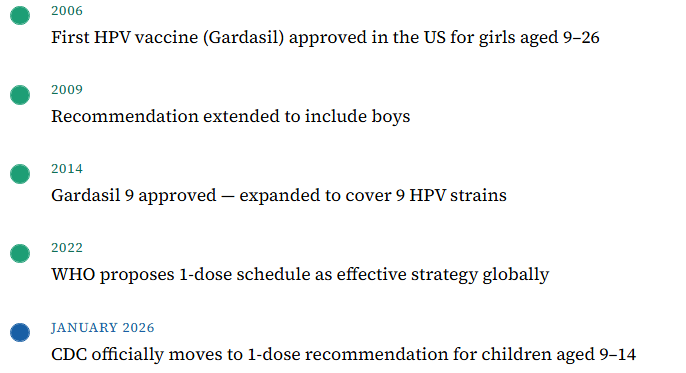
A brief history: how far HPV vaccination has come
HPV Vaccine Side Effects: What’s Normal and What’s Not
Understanding the difference between expected reactions and genuine warning signs gives you confidence on vaccination day.
One of the most common reasons parents hesitate is worry about side effects. The reassuring truth: more than 97% of adverse event reports following HPV vaccination are classified as non-serious, and over 100 million doses have been distributed in the US alone with no unexpected safety signals.
Common reactions: normal and expected
Most side effects from the HPV vaccine are mild and resolve within a few days. They are signs the immune system is responding — not signs that something is wrong.
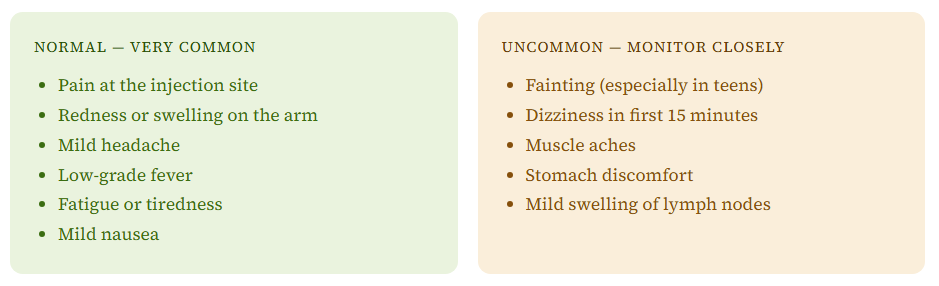
Because fainting can occur after any vaccine injection — especially in preteens and teens — doctors will typically ask your child to sit or lie down and wait 15 minutes after the shot before leaving the clinic. This is standard precaution, not a cause for alarm.
When to call a doctor immediately
Seek Medical Attention If You Notice:
- Signs of a severe allergic reaction: hives, difficulty breathing, swelling of the face, rapid heartbeat
- High fever (above 104°F / 40°C)
- Symptoms that worsen significantly after 48–72 hours
- Unusual neurological symptoms (stiffness, extreme confusion)
Severe allergic reactions (anaphylaxis) are extremely rare — occurring in roughly 3 out of every 1 million doses administered. That’s why your child is observed for 15 minutes post-vaccination and why the vaccine is given in medical settings equipped to handle such reactions.
Who should not get the HPV vaccine?
The vaccine is not suitable for everyone. It should not be given to children who:
- Have had a severe allergic reaction to a previous HPV vaccine dose
- Have a known allergy to yeast (Gardasil 9 is produced using baker’s yeast)
- Are currently pregnant (delay until after birth)
- Are moderately or severely ill at the time of the appointment (reschedule)
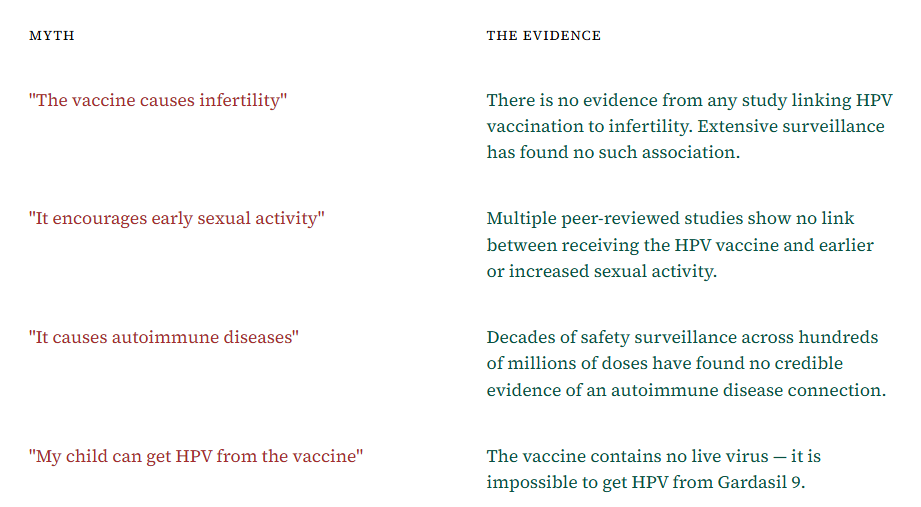
Busting the most common myths
Frequently Asked Questions
Does my child still need the vaccine if they are already sexually active?
Yes — vaccination can still protect against strains your child hasn’t yet been exposed to. While it works best before any exposure, partial protection is still valuable. Talk to your doctor for personalised guidance.
Is the HPV vaccine still needed if my daughter plans to get regular Pap smears?
Both are important. The vaccine prevents most HPV infections from occurring, while cervical screening detects changes if an infection does take hold. They complement — not replace — each other.
Can my child get the HPV vaccine at the same time as other vaccines?
Yes. The HPV vaccine can safely be given alongside other recommended adolescent vaccines, such as the meningococcal and Tdap vaccines, at the same appointment.
What if we missed the recommended age window?
It’s not too late. The CDC recommends catch-up vaccination for all people up to age 26 who weren’t vaccinated earlier. Adults aged 27–45 can also discuss the vaccine with their doctor to decide if it’s appropriate for them.
Will my child need a booster shot later?
Currently, no booster is recommended. Gardasil has shown protection lasting 10+ years and Gardasil 9 shows at least 6 years of effectiveness, with ongoing studies tracking long-term immunity.
The Bottom Line for Parents
The HPV vaccine is safe, effective, and now simpler to administer than ever with the new single-dose schedule. It is your child’s best protection against a set of preventable cancers. Talk to your paediatrician at your child’s next well-child visit — it takes just one conversation and one shot.
Some Quick Links :
1 thought on “Should Your Child Get the HPV Vaccine? A Parent’s Complete Guide”